“Sprawl is a polite word for – when one considers the huge population and small size of Britain an almost unbelievable habit called by D. H. Lawrence ‘doing dirt’. Doing dirt on every available acre of open land particularly in the vicinity of cities. These streets of hell abound around Nuneaton (or did before Civilia took over the site) creating the kind of environment that explains why last year three million housewives in Britain queued up at the surgery for sleeping pills, tranquillisers and anti-depressants.” Ivor de Wolfe
“Pornography is the attempt to insult sex, to do dirt on it.” Pornography and Obscenity (1929) D. H. Lawrence.
Hubert de Cronin Hastings’ (or as per Civilia’s authorship pseudonym “Ivor De Wolfe’s”) opening statement in this work, is evidence of a searing and passionate displeasure toward the current (pre 1971) moment of the British ‘suburban’ trend.
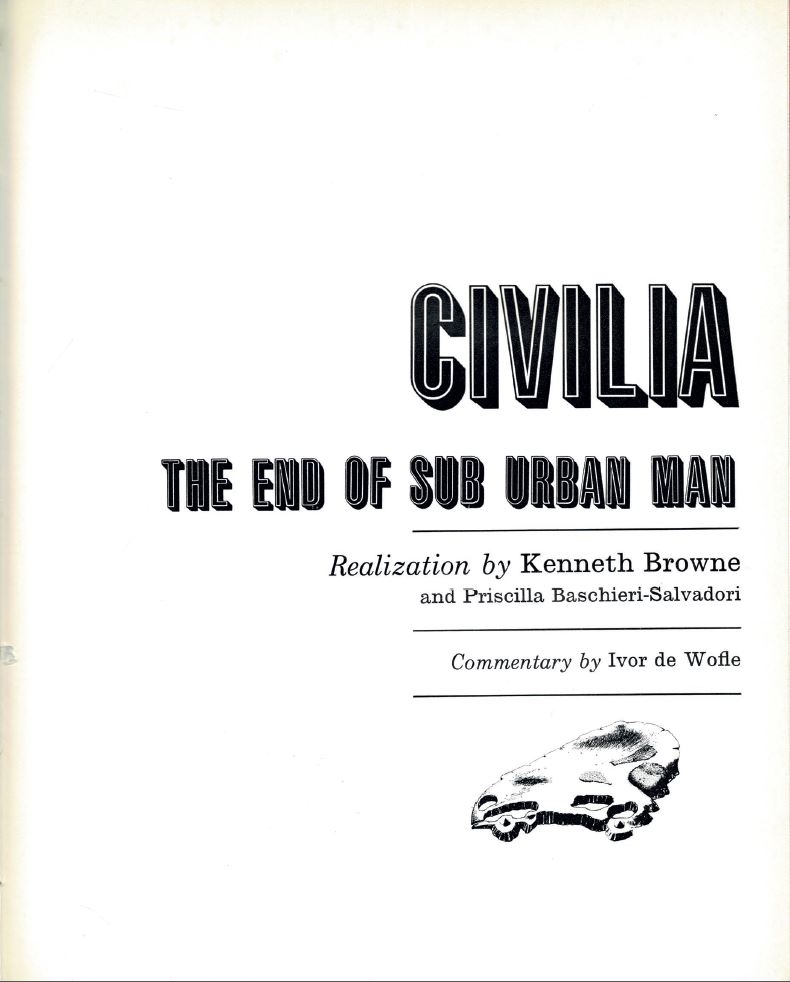
This extract wholly captures the essence of the Civilia project, a visionary and utopian ideal of what Britain’s settlements could, and moreso should, in his eyes, be. First published as a June special edition of the Architectural Review in 1971, and later than year expanded into a book, the project presented as an attack on the concept of suburbia and “the uglification of the countryside”. Hastings, editor of the Architectural Review (1927-1973) and Kenneth Browne, AR’s townscape editor at the time of publication present a virulent reaction to the idea of suburban sprawl, Civilia is revealed as a more holistic and self-contained entity, akin that what we know as ‘city’ today.
Placing his Civilia in the geographical centre of the country, just outside Nuneaton, it was to operate as an aspirational benchmark project for Britain and its populous, the ideal city that resolved Hastings gripes with the status quo of suburbia and provided an idealised view of how we as a nation should (have) operate to achieve heightened wellbeing and happiness within ourselves and environs.
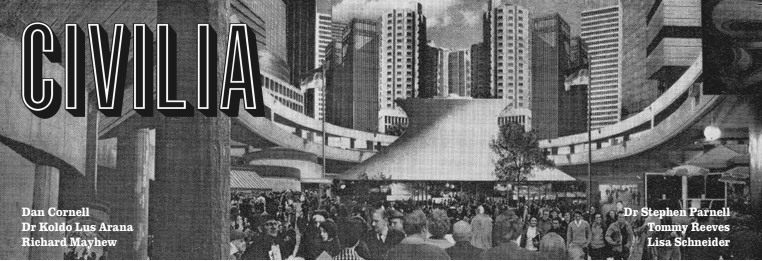
For this initial stage of the project we have been focused on ‘unpicking’ Civilia. The city is presented through 116-collages portraying ten key locations around the city such as: ‘spa’, ‘university’, ‘street’, ‘green’ and ‘home’ with the collages allowing carefully curated views into these worlds.
The first task to begin to understand the ‘construction’ of Civilia has been to identify the buildings which make up the collages. The collages are composed of a backdrop of open countryside views with buildings carefully cut and pasted onto one another often with unnoticeable joints. The selected buildings are primarily of the Brutalist style and all featured in the Architectural Review from circa 1951-1971. At present, we have been able to identify over 70 different buildings and their associated images in the AR, with many repeating frequently throughout the collages as the views often intersect.
We now need help to find the remaining buildings buried within these collages, to assist the ease of searching and to document our progress we are overlaying a coloured filter and numbering system onto each of the collages signifying the ‘found’ buildings leaving the ‘yet to be found’ Brutalist icons hopefully easier to identify. The collages are available to view on both this blog and an Instagram page “@_civilia” which are being updated regularly. If you identify a remaining building(s) in one of the figures, please comment on the Instagram post, blog page or email us at: civilia1971@gmail.com.
 The Civilia Project